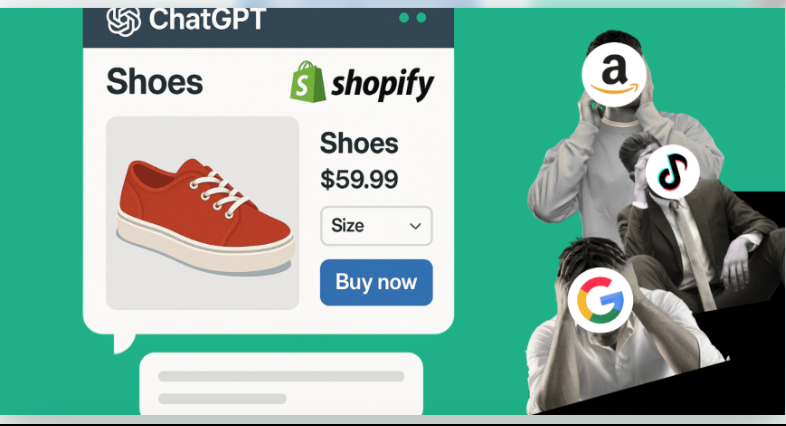
ChatGPT shopping is reshaping ecommerce. In April 2025, OpenAI quietly changed the rules.
No ads. No paid placements. No sponsored slots. Just products that ChatGPT's model has determined are the best match for your query, based on product data, reviews, structured information from across the web, and its understanding of the question.
If you run an ecommerce business and you haven't heard about this yet, that's the problem. Because while you weren't looking, your competitors may already be appearing in those results — and you might not be.
Nearly eight in ten buyers now rely on AI engines for at least half of their purchase decision-making. ChatGPT Shopping is the most direct expression of that trend to date.
What ChatGPT Shopping actually is
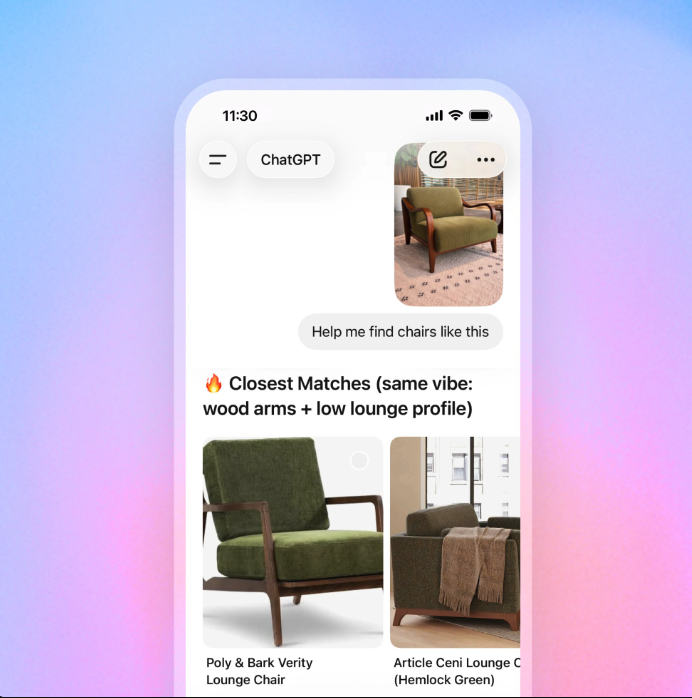
When a user's query has clear commercial intent — they're looking to buy something, compare products, or find the best option in a category — ChatGPT's shopping mode activates automatically. The interface shifts from a text response to a visual product grid, showing typically three to six products with photos, prices, review scores, and a direct link to the retailer.
The products aren't picked randomly. ChatGPT draws on product feeds, merchant data, structured markup on retailer and brand websites, review data from trusted sources, and its broader understanding of quality signals to decide what to surface. Think of it as Google Shopping crossed with a personal shopper — except it doesn't charge for placement, and it's talking to your potential customer before they've even opened a browser tab.
Why this is bigger than it looks
Google Shopping has dominated product discovery for over fifteen years. The formula was simple: pay for Google Ads, get to the top of the shopping carousel. The entire ecommerce marketing playbook was built around that single channel. Google takes roughly 28p in every £1 spent on search advertising in the UK. The dependency was total.
ChatGPT Shopping breaks that model entirely. There are no ads. There is no cost-per-click. There is no bid strategy. There is no Quality Score to optimise. The only thing that determines whether your products appear is whether ChatGPT's model considers them the best answer to the user's question.
That's a fundamental power shift. Visibility is no longer bought. It's earned — through product data quality, structured information, review signals, and how well your online presence communicates quality to an AI model that doesn't care about your ad spend at all.

ChatGPT Shopping shows product carousels with images, prices, ratings and links — directly inside the chat interface, with no ad placements.
What's changed vs. traditional search
How the Instant Checkout actually works — step by step
ChatGPT Shopping isn't just a product recommendation engine — it's a fully transactional interface. OpenAI calls it "Buy it in ChatGPT", and understanding how the purchase flow works is essential for merchants thinking about how it affects their customer relationship.
The critical point for merchants: ChatGPT is a facilitator, not the store operator. You retain ownership of the payment, the customer relationship, fulfilment and returns. What you lose is the customer visiting your site — which has implications for analytics, attribution, and remarketing.
The Agentic Commerce Protocol (ACP) is the open-source technical infrastructure OpenAI built jointly with Stripe. It handles the behind-the-scenes integration between ChatGPT, your merchant backend, and the payment system. Merchants using Stripe can implement it with minimal code changes. ACP is open source — meaning third-party platforms will increasingly adopt it, widening the reach of ChatGPT Shopping beyond OpenAI's own ecosystem.
Current limitations you need to know about
ChatGPT Shopping is powerful but early-stage. There are real constraints that affect how you plan around it:
- Single-item purchases only — multi-item shopping carts are not yet supported. Each transaction is one product. This limits average order value from ChatGPT as a channel, at least until cart support is added (it's on OpenAI's roadmap)
- Analytics blind spot — when a purchase completes inside ChatGPT, you don't get the same behavioural data you'd get from a website visit. Session data, heatmaps, on-site remarketing pixels — none of it applies. This affects fraud prevention modelling and marketing attribution
- US-first, UK imminent — Instant Checkout is live in the US. UK merchants are in the preparation window ahead of the Q1–Q2 2026 expected rollout
- Prohibited categories — alcohol, nicotine, prescription medicines, adult content, weapons and several other categories cannot be submitted at all
- Feed completeness is binary — either your data meets the specification or your products don't appear. There's no partial credit
What's on OpenAI's roadmap
OpenAI has been explicit about what comes next for ChatGPT Shopping. The roadmap includes:
- Multi-item shopping carts — the single biggest limitation will be resolved, enabling full basket purchases inside ChatGPT
- Expanded merchant coverage — beyond the initial Shopify and Etsy integrations, broader platform support is planned
- International expansion — UK and European rollout following the US launch, with further regions to follow
- Broader ACP adoption — the open-source protocol means other AI platforms (Perplexity, Gemini, Copilot) may eventually support the same checkout infrastructure
When multi-item carts arrive, ChatGPT Shopping becomes a full-funnel commerce channel — not just a discovery tool. The merchants who have their feeds live, optimised and trusted by the model before that happens will see the biggest uplift. Getting in early is not just about visibility — it's about building the performance history that AI ranking models weight heavily.
The ecommerce categories feeling it first
ChatGPT Shopping isn't equally disruptive across every product category. The impact is sharpest wherever buyers have always relied on advice and comparison rather than simply picking a product they already know they want. The categories where AI shopping assistants feel most natural are:
- Consumer electronics and tech — "best laptop for video editing under £900" is exactly the kind of query that triggers ChatGPT's shopping mode, and it's already driving significant product discovery
- Fitness and sports equipment — where specs, compatibility and intended use all matter, and users have always wanted guidance, not just a price list
- Home and garden — high-consideration purchases where product attributes and reviews are critical decision factors
- Health and beauty — where personalisation ("best moisturiser for dry skin over 40") makes AI recommendations particularly compelling
- Business software and SaaS — "best project management tool for a 10-person team" is a natural AI query for B2B decision-makers
- Fashion — still evolving, but queries like "comfortable white trainers under £100" are already producing shopping results
If your business operates in any of these categories and you're not yet tracking your visibility in ChatGPT Shopping results, you have a blind spot in your marketing funnel — and you may not know how big it is.
Because most ecommerce businesses haven't yet optimised for ChatGPT Shopping, first movers have a significant advantage. Product feeds that are clean, complete and properly structured will outrank competitors who haven't updated theirs since 2021.
Why most products aren't appearing — and it's fixable
Here's the uncomfortable truth: the majority of ecommerce product data was built to satisfy Google's crawlers in 2019. Product titles are stuffed with keywords. Descriptions are repetitive boilerplate. Attributes like materials, dimensions and compatibility are missing or inconsistent. Review data isn't properly marked up. Structured data is incomplete or outdated.
For Google Shopping, that was fine — the ranking formula was heavily weighted toward bid price, so data quality was a secondary concern. For ChatGPT Shopping, it's the primary concern. The model needs complete, accurate, well-structured product information to confidently recommend your product over a competitor's. If your product feed is patchy, it won't appear.
The three biggest reasons products fail to surface in ChatGPT Shopping are:
- Incomplete product attributes — missing specs, dimensions, materials or compatibility information that the model needs to match products to specific queries
- Thin or missing structured data — no schema markup on product pages, which means the model is guessing at your product's attributes rather than reading them cleanly
- Weak or sparse review signals — review volume, recency and sentiment are significant ranking factors; products with no reviews or very few reviews are consistently deprioritised
The merchant layer problem nobody's talking about
There's a secondary issue that's catching brands off guard. When ChatGPT Shopping surfaces a product, it links to a retailer — not necessarily the brand's own website. If your product is sold through Amazon, Argos, Currys, or other major retailers, ChatGPT may be recommending your product successfully — and sending the checkout traffic to someone else.
This matters because it fragments your customer relationship, reduces your margin, and makes it much harder to build first-party data and repeat purchase behaviour. Brands that only sell through third-party retailers are effectively invisible in the parts of ChatGPT Shopping that matter most for long-term customer acquisition.
The fix requires a deliberate merchant strategy — ensuring your own domain is strong enough to be the preferred link destination, and that your product feed and direct retailer relationships are signalling quality clearly to the model.
What brands need to do right now
The window for first-mover advantage is still open, but it won't stay open indefinitely. The brands that invest in ChatGPT Shopping optimisation in the next six to twelve months will have structural advantages that are very difficult for later entrants to overcome — because AI ranking is heavily influenced by review accumulation, citation history, and data quality built up over time.
The immediate priority list:
- Audit your product feed — identify every attribute field that's missing, inconsistent or below the quality threshold ChatGPT's model needs to work with
- Implement and fix structured data — every product page needs clean Product schema, with price, availability, reviews and key specifications properly marked up
- Track your shopping visibility — you need to know which of your products are appearing, in which positions, for which queries, and how that compares to your closest competitors
- Build a review strategy — ethical, systematic review generation and distribution is now an SEO priority, not just a nice-to-have
- Review your merchant relationships — understand which retailers are capturing your ChatGPT Shopping clicks, and whether your own site should be competing for that traffic directly
The UK situation — and when to expect it
If you're a UK-based ecommerce business, the honest answer is: ChatGPT Shopping is not yet fully live for UK consumers in the same way it is in the US. The feature launched in America in April 2025, initially through a trial with Etsy before rolling out more broadly to Shopify merchants. UK and European availability has been delayed — primarily due to data privacy regulatory considerations under UK GDPR and the EU AI Act framework.
That said, the timeline is close. The UK rollout has been widely anticipated for Q1–Q2 2026, which means if you're reading this now, it is either imminent or already beginning. OpenAI has been working through the regulatory and merchant integration requirements needed to operate in the UK, and the infrastructure — built on OpenAI's Agentic Commerce Protocol (ACP), co-developed with Stripe — is already in place.
The UK rollout is expected to include OpenAI's Instant Checkout feature — allowing users to complete purchases directly inside ChatGPT without leaving the chat. Merchants using Stripe can integrate with minimal code changes. Payment tokens are encrypted and merchants retain control of fulfilment and the customer relationship.
What this means in practice
The regulatory delay has created an unusual window. UK businesses that start optimising for ChatGPT Shopping now — before it goes live for consumers — will have a structural head start that is very difficult to close once the feature is active. The businesses that appear in the first wave of UK ChatGPT Shopping results will be the ones whose product data, structured markup and review signals were already in order when the crawlers came looking.
Waiting until the UK launch is confirmed before beginning optimisation is the wrong move. By the time it's confirmed, you'll be three to six months behind competitors who were already preparing.
US launch: April 2025 — Shopify merchants, no ads, organic ranking
UK expected: Q1–Q2 2026 — regulatory clearance in progress, Stripe integration confirmed
Instant Checkout: Included in UK rollout — in-chat transactions without leaving ChatGPT
Multi-item carts: Planned for a later phase — single-item purchases first
How Beaconsfield Business Solutions helps
- Our ChatGPT Shopping Visibility service tracks your product rankings across ChatGPT shopping results in real time — telling you exactly which SKUs appear, for which queries, and where competitors are taking your placements.
- We audit and fix your product feeds and structured data end to end — every attribute field, every schema markup error, every inconsistency that's causing ChatGPT's model to skip your products in favour of better-data alternatives.
- Our merchant layer analysis identifies which third-party retailers are capturing your ChatGPT Shopping traffic and builds a strategy to reclaim direct-to-consumer visibility where the margin and customer relationship value are highest.
- We deliver competitive gap reports showing every query where your competitors appear in ChatGPT Shopping and you don't — segmented by category, price point and query intent — giving you a precise, prioritised action list.
ChatGPT Shopping is not a trend to monitor from a distance. It's a structural change to how products are discovered online — as significant as the original launch of Google Shopping in 2002. The difference is that this one is moving faster, and the businesses that move first will be the ones who are hardest to displace.
If you sell products online and you haven't yet thought about your ChatGPT Shopping strategy, now is the time. The products appearing in those results in six months' time will be the ones that started optimising today.